Science
Which comet's 1066 appearance was stitched into the Bayeux Tapestry?
- Halley's Comet
- Encke's Comet
- The Great Comet
The answer is Halley's Comet. Halley's — an omen over Hastings.
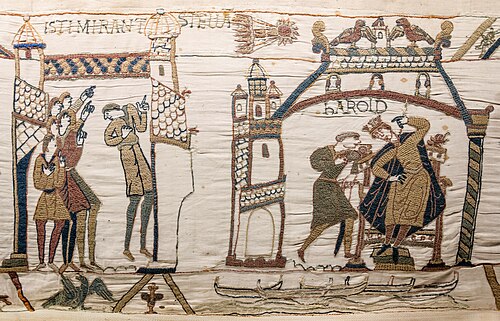
Halley's Comet appeared in the spring of 1066, a few months after Harold Godwinson took the English throne and a few months before he lost it at Hastings. The Bayeux Tapestry shows a group of men pointing up at it with the caption ISTI MIRANT STELLA - these men wonder at the star - while Harold sits below on his throne looking distinctly unwell, and a row of ghostly ships is stitched into the lower border beneath him.
Nobody in 1066 knew it was a returning object. That was Edmond Halley in 1705, applying Newton's new theory of gravity to the recorded comets of 1531, 1607 and 1682, noticing that the orbits were the same, and concluding they were one body coming back roughly every seventy-six years. He predicted its return for 1758. It appeared on Christmas night that year, sixteen years after his death, and the point at which a comet stopped being an omen and became a calculation is usually dated to that evening.
Once you know the period you can go looking backwards, and the sightings run all the way to 240 BC in the Chinese records. Giotto seems to have painted the 1301 apparition as the star over Bethlehem, which is why the European probe sent to photograph the comet's nucleus in 1986 was named after him. Mark Twain, born under the 1835 apparition, said he expected to go out with the next one, and did.