Science
Which element, number 43, was the first to be artificially produced?
- Technetium
- Promethium
- Francium
The answer is Technetium. 'artificial' in Greek.
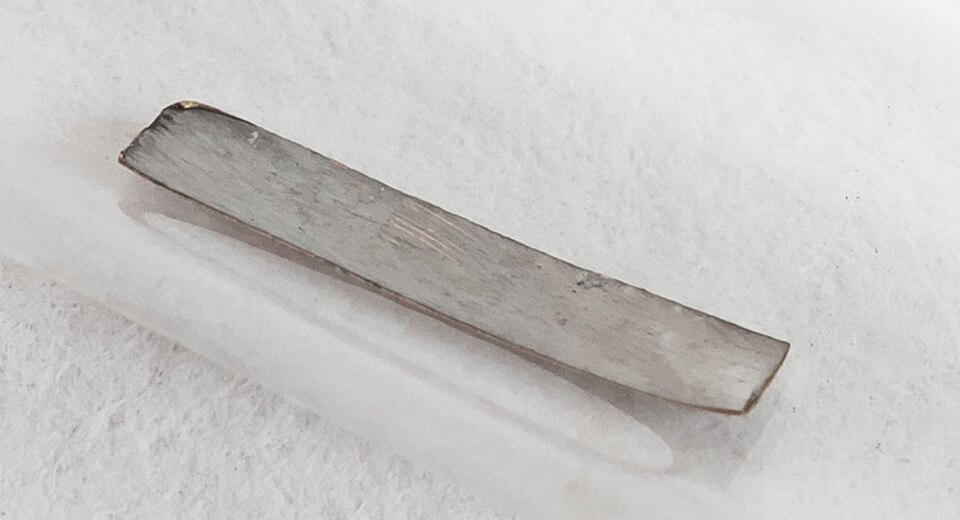
Mendeleev's periodic table left a gap beneath manganese, and for sixty years chemists kept announcing they had filled it. They had not. The element was finally made rather than found: in 1937 Carlo Perrier and Emilio Segre, working in Palermo, chemically picked it out of a strip of molybdenum foil that Ernest Lawrence had bombarded with deuterons in the Berkeley cyclotron and posted to them. They named it from the Greek tekhnetos, artificial.
The reason nobody found it in the ground is that it barely stays there. Every isotope of technetium is radioactive, and the longest-lived, technetium-98, has a half-life of about 4.2 million years - a long time by human reckoning and nothing at all against the age of the Earth. Whatever the planet formed with has decayed away, leaving only the traces that uranium ore makes for itself through spontaneous fission.
Two afterlives make it more than a curiosity. Technetium-99m, which decays with a half-life of six hours and emits a gamma ray convenient for cameras, is the most-used radioisotope in medicine, behind tens of millions of diagnostic scans a year. And in 1952 Paul Merrill found technetium's fingerprint in the light of red giant stars. Since the element cannot have survived from their formation, the stars had to be making it - the first direct evidence that nucleosynthesis is happening now, inside stars we can see.