Science
What is the Chandrasekhar limit approximately?
- 1.4 solar masses
- 3.0 solar masses
- 0.5 solar masses
The answer is 1.4 solar masses. About 1.4 solar masses — the white dwarf ceiling.
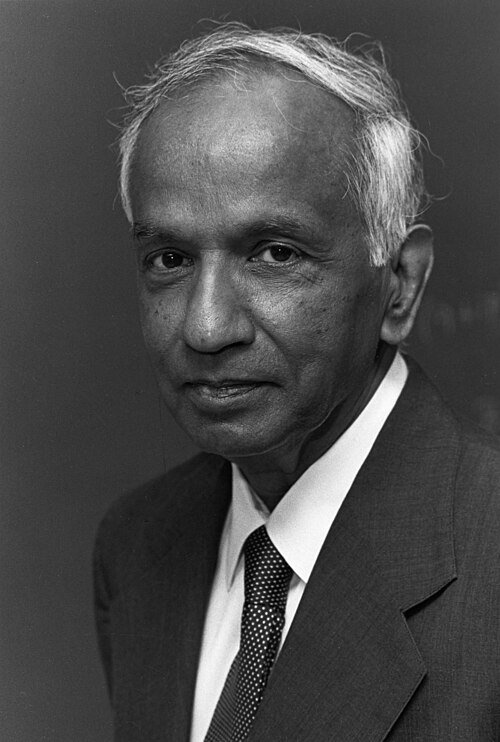
A white dwarf is what a star leaves behind when it can no longer burn: a ball of carbon and oxygen about the size of the Earth, held up not by heat but by electron degeneracy pressure, the quantum refusal of electrons to occupy the same state. Subrahmanyan Chandrasekhar worked out on the boat from Madras to England in 1930, aged nineteen, that this refusal has a ceiling. Pile on more than about 1.4 solar masses and the electrons must move at close to the speed of light, at which point they stop pushing back hard enough and the star collapses.
Arthur Eddington, then the most powerful astrophysicist alive, ridiculed the result in front of the Royal Astronomical Society in 1935 - there ought to be a law of nature, he said, to prevent a star behaving so absurdly. He was wrong, and the episode cost Chandrasekhar years. He received the Nobel Prize in 1983.
The limit turns out to be one of the most useful numbers in astronomy. A white dwarf pulling matter off a companion until it reaches that threshold detonates, and because it always detonates at the same mass, it always shines with nearly the same brightness. That makes Type Ia supernovae standard candles, and it is by measuring them that astronomers found in 1998 that the expansion of the universe is accelerating.