Science
Which deep-Earth mineral makes up most of the lower mantle?
- Bridgmanite
- Olivine
- Quartz
The answer is Bridgmanite. The planet's most abundant mineral.
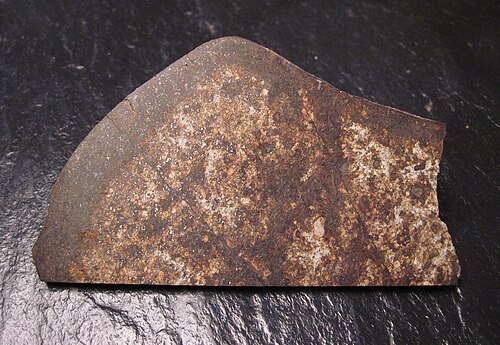
Bridgmanite is a magnesium iron silicate squeezed into a dense crystal structure, and it makes up something like 38 per cent of the volume of the Earth. It fills the lower mantle, from about 660 kilometres down to nearly 2,900, which makes it comfortably the most abundant mineral on the planet.
Nobody had ever seen a piece of it. Its existence and its properties were worked out from seismology and from laboratory experiments that reproduce the pressures involved, and that was enough to be confident about what the middle of the Earth is made of - but not enough to name it. The International Mineralogical Association will not accept a mineral name without a natural specimen to point at, and specimens from 1,000 kilometres down do not come up.
The sample eventually arrived from space. In 2014 Oliver Tschauner and colleagues identified it inside the Tenham meteorite, an Australian fall in which an ancient high-speed collision had briefly generated the pressures of the lower mantle and frozen the result. Only then could it be named, for Percy Bridgman, who won a Nobel Prize for inventing the high-pressure apparatus that made this whole field possible. The commonest mineral on Earth got its name in 2014, from a rock that fell out of the sky.