History
Which Greek engineer built a steam-turbine toy, the aeolipile?
- Hero of Alexandria
- Archimedes
- Ctesibius
The answer is Hero of Alexandria. Hero, in the 1st century AD.
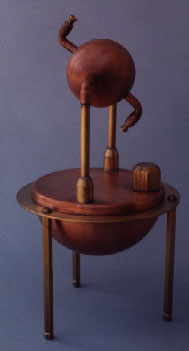
Hero of Alexandria, working around the middle of the first century AD, described a hollow bronze sphere mounted on bearings above a cauldron, with two bent nozzles projecting from its sides. Boil the water, and steam escaping from the nozzles spins the sphere. It is a reaction turbine, and it is the same principle as a jet engine, roughly seventeen centuries before anyone did anything useful with it.
Hero was not a lone genius so much as a working engineer with a taste for the theatrical. The same books describe temple doors that swing open by themselves when the altar fire is lit, a machine that dispenses a measured amount of holy water when a coin is dropped in - a fair claim to being the first vending machine - and a small automated theatre driven by falling weights and a rope wound round a drum, in which the sequence of movements can be changed by rewinding the rope differently. That is a programmable machine.
So why no industrial revolution? Partly physics: the aeolipile produces a trivial amount of torque and no way to take power off it, and nothing in ancient metallurgy could have held a useful pressure. Partly economy: there was no shortage of muscle to be had, and no bottleneck that a small unreliable engine would have relieved.
What is not in doubt is that the thing was built, written up, and understood as a curiosity by everyone including the man who made it. Hero was a working engineer with a taste for the theatrical, and the aeolipile sits in his books among the temple tricks rather than among the tools.