Arts & Letters
Who painted Las Hilanderas (The Spinners)?
- Velazquez
- Zurbaran
- Ribera
The answer is Velazquez. Myth hidden in a workshop scene.
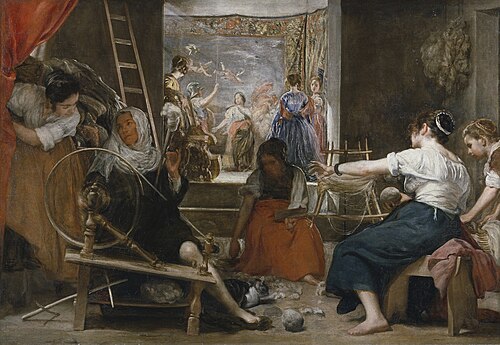
For a long time Las Hilanderas was taken for what it appears to be: Velazquez painting working women at their wheels in the royal tapestry workshop, an unusually sympathetic piece of everyday observation from around 1655.
Then look through the arch. In the brightly lit alcove at the back stands a helmeted figure confronting a young woman in front of a tapestry, and the tapestry is a reproduction of Titian's Rape of Europa, which hung in the Spanish royal collection where Velazquez saw it daily. The subject is Athena and Arachne - the mortal weaver who challenged the goddess, produced work that could not be faulted, and was destroyed for it.
So the painting is about its own trade. The women in the foreground are doing the labour; the myth in the background is about what happens when the craftsman is better than the god, and Velazquez has placed a masterpiece by his own greatest predecessor at the centre of it. He is also quietly making the case that painting is a liberal art rather than manual work, an argument he pursued his whole career at a court that was not sure.
One detail repays standing close. The spokes of the spinning wheel on the left are not painted as spokes but as a blur, because they are turning. It is one of the earliest attempts anywhere to paint motion as the eye actually receives it.