History
Which French mathematician died in a duel at twenty?
- Evariste Galois
- Niels Abel
- Sophie Germain
The answer is Evariste Galois. Galois, in 1832 - his group theory outlived him by a century.
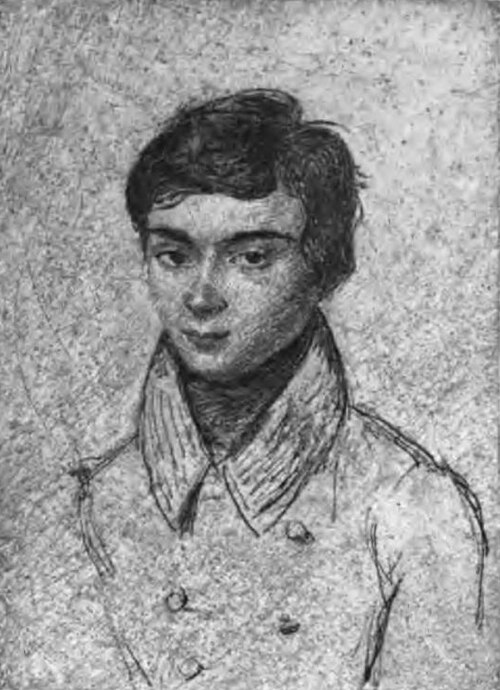
Evariste Galois was shot in the abdomen on the morning of 30 May 1832 and died the next day of peritonitis, aged twenty. He had been a republican agitator, jailed twice, and the duel appears to have been over a woman rather than politics, though the details have never been settled and probably cannot be.
By then he had already answered a question mathematicians had been circling for three hundred years. There are formulas for solving quadratic, cubic and quartic equations. For the fifth degree there is none, which Abel had recently proved - but nobody could say what it was about an equation that made it solvable or not. Galois found the answer by inventing a new kind of object: attach to each equation a group describing the symmetries among its solutions, and the structure of that group tells you immediately whether a formula can exist. Group theory, one of the load-bearing walls of modern mathematics, comes out of this.
Getting anyone to read it was another matter. He failed the entrance examination to the Ecole Polytechnique twice. One memoir sent to the Academy of Sciences was lost when Fourier, who had it, died. Another came back from Poisson marked as incomprehensible - which, given the state of the manuscript, was not unreasonable.
Liouville finally published the work in 1846, fourteen years after the funeral, and it took decades more for its full reach to be understood. Galois theory is now the standard way of thinking about symmetry in mathematics, and the objects he invented turn up everywhere from crystallography to error-correcting codes.