Geography
Which island's moai quarry is the volcanic crater Rano Raraku?
- Easter Island
- Pitcairn
- Tahiti
The answer is Easter Island. Most moai never left the quarry.
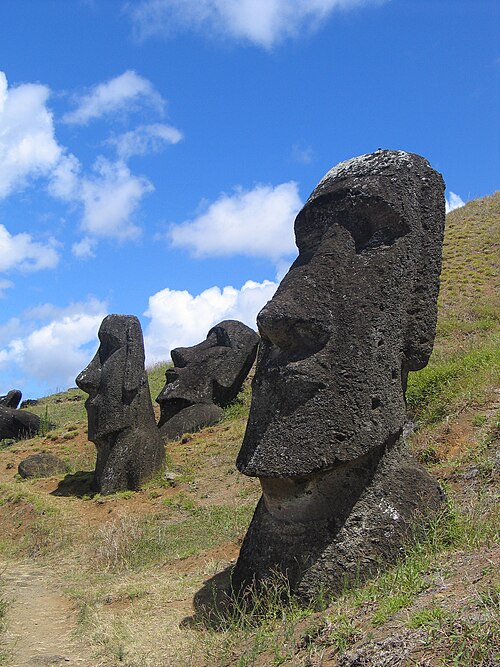
Nearly every moai on Rapa Nui came out of one hillside. Rano Raraku is a crater of volcanic tuff, soft enough to carve with basalt picks and hard enough to stand up afterwards, and something like 95 per cent of the roughly 900 statues on the island were cut there. About 400 never left: they stand in the slope in every stage of production, including one still lying on its back attached to the bedrock, about twenty-one metres long and far too big to have ever been moved.
The famous heads are not heads. Excavation at Rano Raraku showed that the statues standing in the quarry slope have full bodies, buried over centuries by erosion washing down the hill - which is also why they are the best preserved carvings on the island.
How the finished statues travelled to the coastal platforms was argued over for decades, and the answer islanders had given all along was that they walked. Experiments with a full-size replica showed that a statue with a forward-leaning centre of gravity can be rocked side to side with three ropes and made to shuffle upright, quite quickly, by a modest team - which fits the shape of the unfinished statues and the roads they were moved along.
Roughly a thousand years of carving produced around 900 statues on an island of 164 square kilometres, which is a statue for every few dozen people at any one time. They get larger over the centuries, which is usually read as competition between lineages, and the last of them were never finished.