Nature & Beasts
Which moon shows geysers of water ice from its south polar 'tiger stripes'?
- Enceladus
- Europa
- Triton
The answer is Enceladus. Feeding Saturn's E ring.
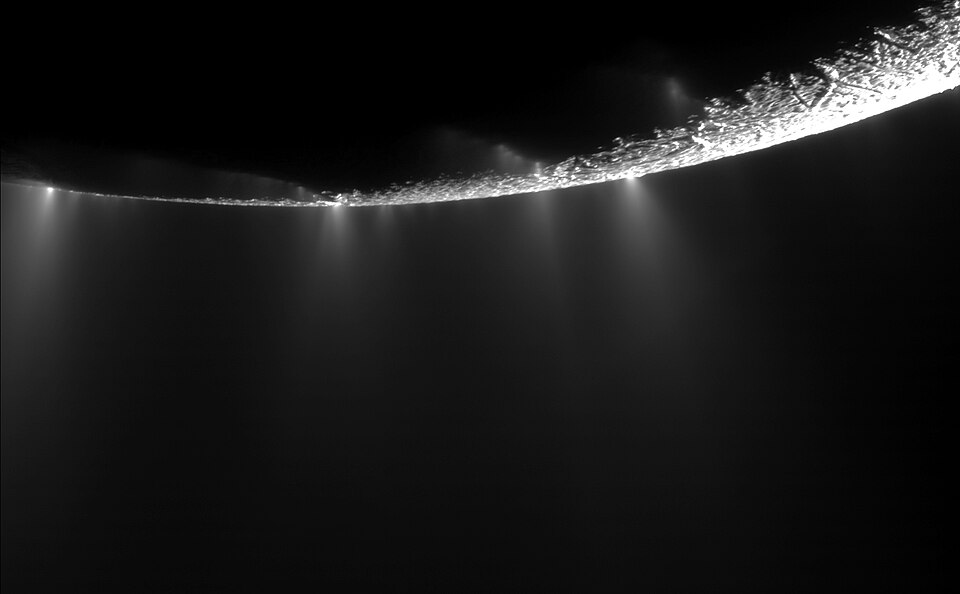
Enceladus is about five hundred kilometres across - small enough to fit inside Great Britain - and it should by rights be a dead ball of ice. In 2005 the Cassini spacecraft found it venting. Four roughly parallel fissures near the south pole, warmer than the ground around them and nicknamed the tiger stripes, throw plumes of water vapour and ice grains hundreds of kilometres into space. Most of that material falls back; the rest becomes Saturn's diffuse E ring, which the moon is therefore continuously manufacturing.
Cassini did something no mission had done before: it flew through the plume and sampled it directly, repeatedly. The grains carried salts, which means the water has been in contact with rock. They carried silica nanoparticles of a size that forms at around ninety degrees Celsius, which points to hydrothermal vents on a sea floor. In 2017 the spacecraft reported molecular hydrogen - a chemical energy source that microbes on Earth live on. In 2023 phosphates turned up in E-ring grains, the last of the elements life is built from to be checked off.
Beneath the ice there is a global ocean, established not by drilling but by watching the moon wobble: Enceladus librates by more than a rigid body could, so its shell must be floating free of its core. A world this size has no business staying warm, and the answer is Saturn's tides kneading it in an orbit that Dione keeps from settling down.