General Knowledge
Which shipwreck yielded the oldest known analog 'computer' alongside bronzes?
- Antikythera
- Uluburun
- Mary Rose
The answer is Antikythera. Wreck, found 1900.
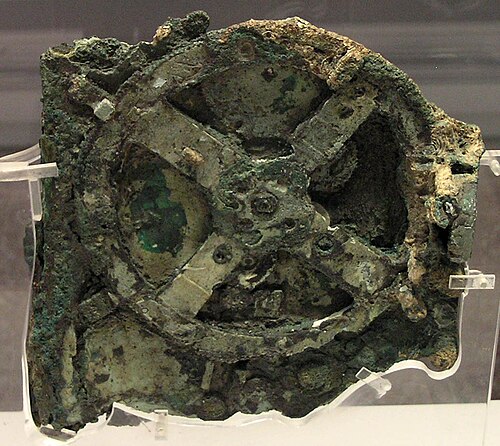
In 1900 sponge divers sheltering from a storm off the island of Antikythera found a Roman-era wreck in forty metres of water, and brought up bronzes and marbles - among them the Antikythera Youth, one of the finest Greek bronzes to survive. The lump of corroded metal that mattered most sat unregarded until 1902, when the archaeologist Valerios Stais noticed a gear wheel in it.
It is a geared astronomical calculator, built in the second century BC, with at least thirty bronze gears cut by hand. Turn the crank and the front dial shows the date against the zodiac and the positions of the sun and moon, with a half-silvered ball rotating to give the moon's phase. The back dials run the calendrical cycles: the nineteen-year Metonic cycle, the Saros cycle of 223 lunar months for predicting eclipses, and a four-year dial marking the games, Olympia among them.
Nothing of comparable intricacy is known again until the astronomical clocks of fourteenth-century Europe, a gap of some fifteen hundred years. Most of what we now know came from X-ray computed tomography in 2005 and 2006, which read more than two thousand characters of inscription off the inside of the corroded fragments - an instruction manual, in effect, that had been unreadable for two millennia.